
Banh mi isn’t the most famous dish in Hue. But if you choose the right place, it’s still worth trying.
The problem is that many tourists stop at easy-to-find spots that are fairly average and not especially memorable.
This isn’t a list of every banh mi stall in Hue, only the ones worth your time.
1. What Makes Banh Mi in Hue Different?
Hue’s banh mi leans toward stronger, more savory flavors, often with a light touch of fermented shrimp paste, and a distinct sauce.
Preparation is simple, service is quick, and it’s made for how locals actually eat day to day.
It’s not something you stop to photograph, but something you eat on the go and move on.
2. Popular Banh Mi Shops in Hue to Taste
You can find many Banh Mi shops around Hue City, but the three below are the places that have their own characters to be noticed.
2.1. Banh Mi Ba Bu
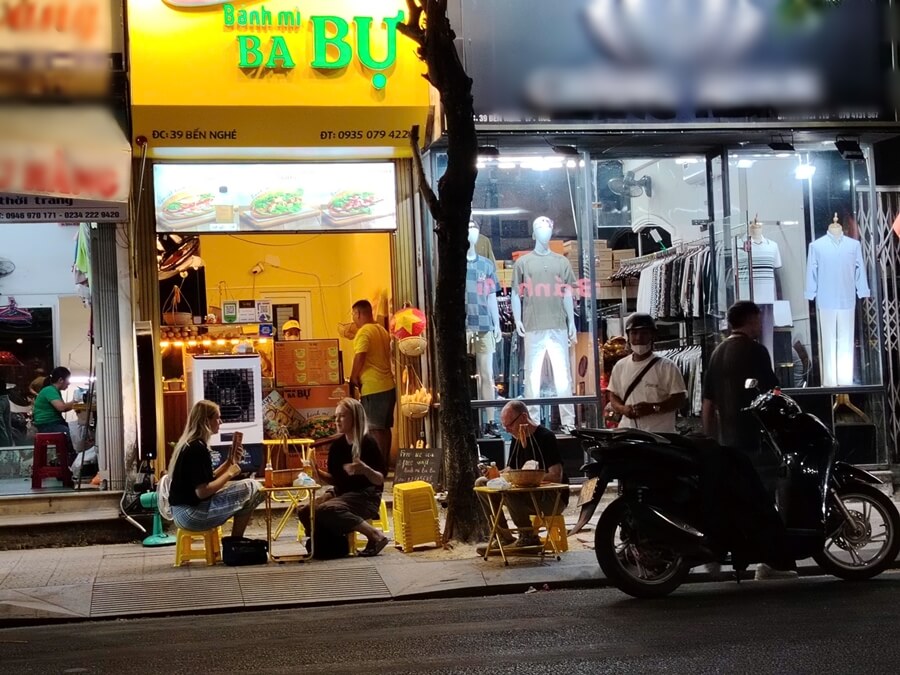
📍 Address: 39A Ben Nghe Street, Hue City
What it actually feels like:
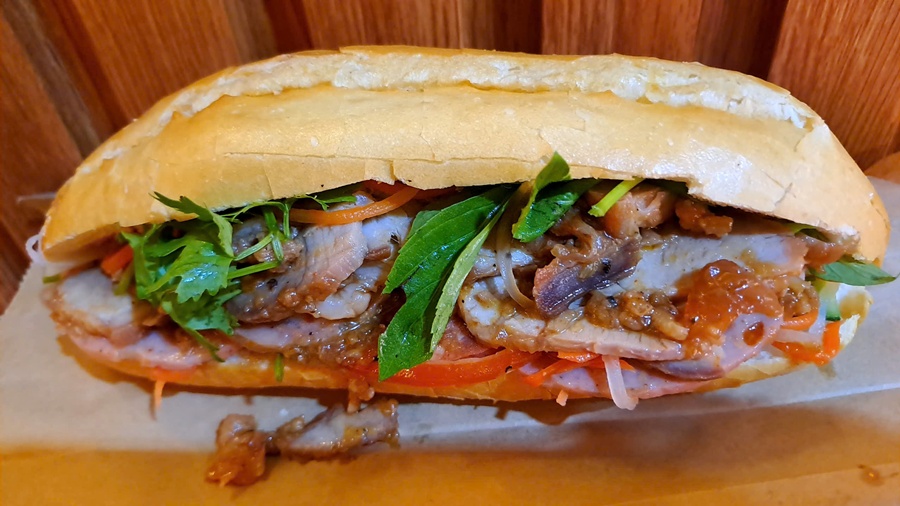
When you take the first bite of Banh Mi Ba Bu on the spot, the crust is crisp but not too loud, still slightly warm from the oven.
The pork is on the drier side, but it’s balanced immediately by fresh, crunchy greens. Every few bites, a hint of herbs rises in the back of your mouth, subtle, but noticeable if you pay attention.
As you go deeper into the sandwich, the layers become clearer. You start to see thin strips of papaya and lightly colored carrot tucked between the greens, with small pockets of white mayonnaise appearing unevenly inside.
It’s not a “perfectly mixed” banh mi, you experience it in layers.
The detail that explains everything:
Ba Bự doesn’t use pate. Instead, they replace it with a house-made pork sauce and mayonnaise. According to the vendor, Hue’s hot and humid weather doesn’t work well with storing pate, so they adapted. That’s why the sandwich feels lighter, but also slightly less rich than what you might expect elsewhere.
What you’ll notice if you stand nearby:
Many local customers come and order directly when still on motorbikes, call out: “Cho anh một ổ mì đặc biệt,” (A special bread), and leave within 2–3 minutes. No hesitation, no questions, just routine.
When it works best:
- Morning: fresh, warm, best texture
- Late afternoon (before ~7 PM): still good
- After that: not worth planning for. They often discount 50% from 8:00 PM – 9:00PM.
Best if you want a lighter, herb-forward banh mi that reflects how locals actually eat in Hue; not if you’re looking for a rich, pate-heavy version.
2.2. Banh Mi O Tho
📍 Address: 14 Tran Cao Van Street, Hue City
What makes it feel different right away:
Unlike Bánh Mì Ba Bự, where everything is kept neatly behind glass on a busy street, O Tho feels more open and more local.
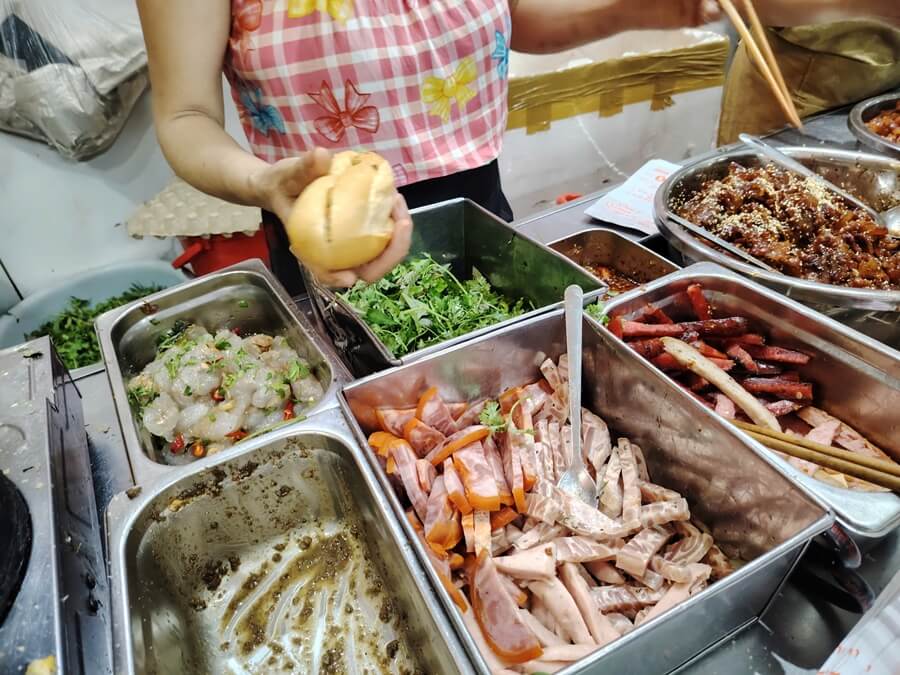
Located on Văn Cao Street, where things move slower, the ingredients are laid out directly on a low table. When you walk in, it doesn’t look like a typical sandwich stall. It feels closer to a small buffet, already prepared and waiting for ordering a Hue bread with its local taste.
How people actually order here:
Even though there’s a menu with prices, most people don’t read it.
They point:
- “Chả.” (Meat pie)
- “Trứng.” (Fried egg)
- “Thịt nướng.” (Grilled pork)
And that’s it.
The seller moves quickly, adding each ingredient, then finishes with herbs, cucumber, and a light drizzle of sauce.
What that sauce changes:
There’s a subtle hint of shrimp paste (mắm ruốc) in the sauce and in ingredients when marinating meat; not strong, but enough to notice after a few bites.
It doesn’t hit immediately. But once it settles, it gives the sandwich a deeper, slightly fermented note that you won’t find in banh mi outside Hue. That’s the part that makes it distinctly local.
The size changes the experience:
The bread of this shop is noticeably smaller than Bánh Mì Ba Bự.
That changes how you eat it. You don’t need to go through several bites to reach the “core”, everything is there from the first bite. Meat, pickles, herbs, sauce, all at once. It feels more direct, less layered.
Pricing, simple but easy to underestimate: ~12,000 VND if you choose just one filling. Price increases with each added ingredient. It starts cheap, but most people don’t stop at one.
What you’ll notice at night:
O Tho opens late and runs into the night, sometimes until midnight. The busiest time is around 7–9 PM.
People don’t come for just one sandwich. It’s common to see someone order 4–5 at once, pack them up, and leave. This is more of a takeaway habit than a sit-and-eat spot.
Best if you want a customizable, distinctly Hue-style banh mi with that subtle mắm ruốc depth, not if you’re expecting a standard, neatly assembled sandwich. This is one of the few places where you can “build” your own banh mi in Hue, in a way that still feels completely local.
2.3. Banh Mi Bao Thanh
📍 Address: 265 Tran Hung Dao Street, Hue City
Why people stop here:
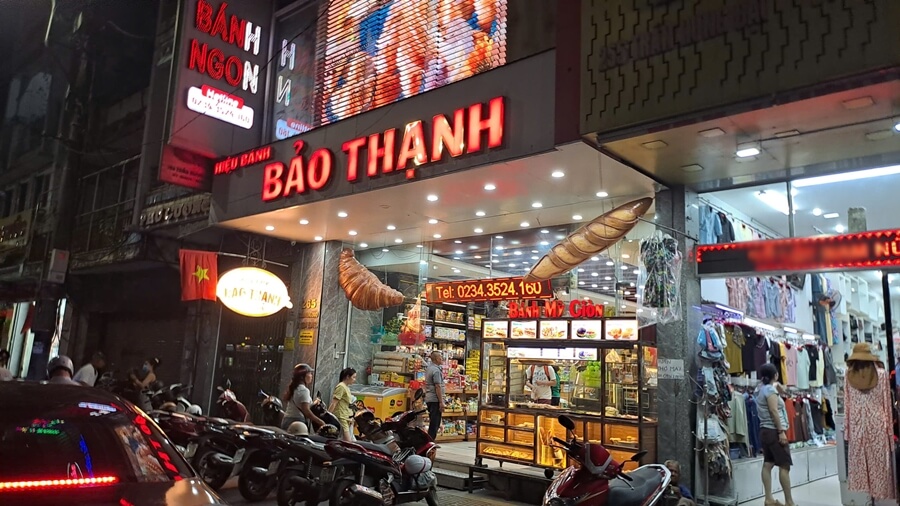
Right in front of Dong Ba Market, Bảo Thanh is easy to notice, not because of a crowd, but because it’s part of a larger bakery.
This isn’t a street stall. It feels more structured, more “shop-like,” and that changes the experience immediately.
What it actually tastes like:
The banh mi here is straightforward. Cold cuts, pate, herbs, a bit of onion, familiar components, nothing unusual. Compared to Bánh Mì Ba Bự or O Tho, the filling feels lighter and less packed, and the flavor doesn’t push as strongly.
But the bread is where it stands out. Because it’s baked on-site, the crust feels fresher, slightly warmer, with a clean, light crispness that’s different from typical street stalls. This is less about intensity, more about simplicity.
What makes it useful in your route:
This isn’t where you go for a “best banh mi in Hue” experience. It’s where you stop without planning.
After walking through the market, when you want something quick, familiar, and easy to carry, this works. It’s also one of the few places where you can combine things:
- grab a banh mi
- pick up some pastries or sweets
- take them back as a small gift
A small timing detail (worth knowing):
The shop is open from morning until around 9–10 PM.
But Hue’s heat affects things more than you might expect. Around late morning to mid-afternoon (roughly 10 AM – 3 PM), even freshly prepared ingredients can lose some of their crispness more quickly. It doesn’t make the sandwich bad, just slightly less vibrant than earlier in the day.
If you want the best texture, earlier or later in the day works better.
Best as a convenient, bakery-style banh mi stop near the market; not for bold flavor, but for a quick, familiar taste of Vietnam that fits naturally into your day. Not every banh mi stop in Hue needs to be memorable, some just fit naturally into your route.
3. Which Banh Mi in Hue should you pick?
Side by side, the difference isn’t about which one is “better”, it’s about who it fits:
- Banh Mi O Tho most clearly reflects the way locals in Hue eat among the three places. It suits locals very well, and I also noticed quite a few Vietnamese travelers stopping by. For international visitors, especially those used to higher service standards, this may not be their first choice.
- Banh Mi Ba Bu is much more approachable.
Run by a younger owner, the setup feels cleaner and more modern. Ingredients are more standardized, making the taste consistent and easy to enjoy. This is where most travelers, including international ones, will feel at ease. - Banh Mi Bao Thanh doesn’t try to stand out.
But it fits well as a convenient stop, especially near Dong Ba Market when you just need something quick after missing a meal.
It’s not about finding the “best” one. It’s about finding what fits you at that moment.
4. What Hue Flavor includes (and what it doesn’t)
Hue Flavor doesn’t include banh mi in its food experience.
Not because banh mi in Hue isn’t good, but because in Vietnam, there are many other places where banh mi stands out more, such as Hoi An or Ho Chi Minh City. These have already shaped expectations for many travelers in terms of flavor and variety.
Instead of repeating that, Hue Flavor focuses on dishes that are truly local to Hue, the kind you’re unlikely to fully experience elsewhere, both in taste and in story.
If you still want to try banh mi, start with Banh Mi Ba Bu, it’s approachable and works well for most travelers.
If you prefer to explore on your own, continue with our Hue local foods guide for more local specialties.
And if you want a deeper experience, beyond just eating, our Hue Flavor Street Food Tour brings everything together.
“We don’t show you what Vietnam already does well.
We show you what only Hue does.”
5. Conclusion
Banh mi in Hue isn’t something you need to seek out at all costs. But if you’re here, it’s still a small experience, enough to give you a better sense of how people in Hue actually eat.
Banh Mi Ba Bu is easy to approach and works well for most travelers. Banh Mi O Tho reflects the local rhythm most clearly. And, Banh Mi Bao Thanh is a convenient stop when you need something quick.
And perhaps that’s enough for banh mi in Hue. The rest of the journey lies in other dishes.
Explore More Hue Food
If you’re curious about what truly defines Hue’s food, these are the dishes worth your time:
- Bun Bo Hue: rich, layered, and central to Hue’s identity
- Com Hen: simple, local, and surprisingly complex in flavor
- Banh Khoai: crispy, hands-on, and distinctly Hue in both taste and how it’s eaten