
For the people of Hue, beef noodle soup is a local delicacy they are proud of and love to share with visitors from afar. It embodies the soul and culinary culture of Hue, captured in every spoonful of its fragrant, savory, and richly layered broth.
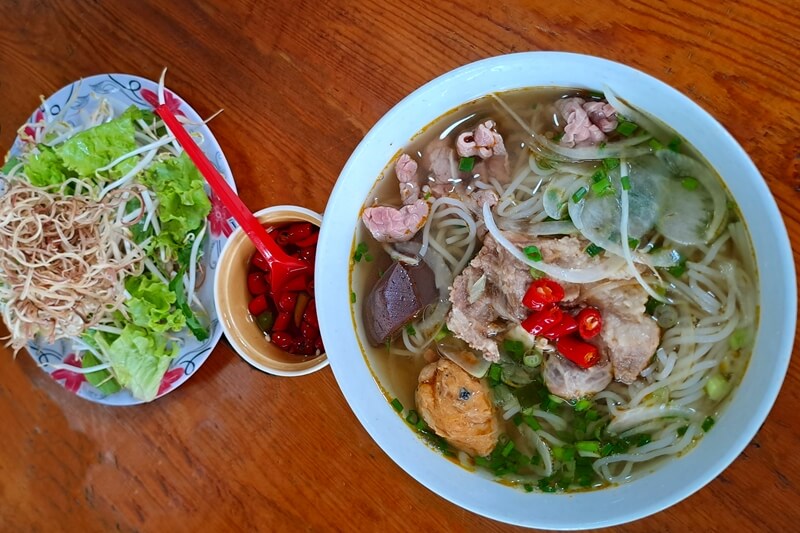
A truly authentic bowl of beef noodle soup is served with a plate of fresh raw vegetables, a wedge of lime, and sliced fresh chili in fish sauce.
While most restaurants offer these basic accompaniments, each place brings its own unique flavor and serving style.
In this article, you’ll learn how to eat Bun Bo Hue properly, where to try it, and what to expect in terms of price.
1. What Is Bun Bo Hue?
Bun Bo Hue, often referred to as Hue beef noodle soup, is one of the most distinctive culinary symbols of Hue City, the former imperial capital of Vietnam. While the dish can now be found across the country, its original flavor and character remain deeply rooted in Hue’s culinary traditions.
Unlike other Vietnamese noodle soups, Bun Bo Hue is known for its bold, layered broth. The soup is typically simmered from fresh beef bones for many hours to extract natural sweetness and depth. Pork leg is often added for richness, along with beef shank or slices of rare beef. What truly defines the broth, however, is the combination of lemongrass and shrimp paste, which creates a powerful aromatic foundation. A touch of chili oil and annatto gives the soup its signature reddish hue and shimmering surface.
Local belief also associates the unique flavor of Bun Bo Hue with the water source of the Perfume River (Huong River). Although this remains a cultural perspective rather than a scientific conclusion, many Hue residents insist that traditional broth cooked with local water develops a harmonious balance that is difficult to replicate elsewhere.

Another defining feature lies in the vermicelli noodles. The noodles used in Bun Bo Hue are round, slightly thicker than southern varieties yet not as large as some northern types. Made from a carefully balanced mixture of rice flour and tapioca flour, they are soft but pleasantly chewy, allowing them to absorb the robust broth without breaking apart.
Historically, Bun Bo Hue is believed to have appeared around the 16th century during the time of Lord Nguyen Hoang. Local folklore tells the story of “Nàng Bún,” a talented young woman who perfected vermicelli-making and helped shape the early form of this dish. Whether legend or history, her story reflects the deep cultural roots of Bun Bo Hue in the land of Hue.
Today, Bun Bo Hue is not simply a noodle soup. It represents the culinary identity of central Vietnam, refined, bold, and unapologetically flavorful.
Bun Bo Hue is just one of many traditional dishes you can discover when exploring the local foods in Hue.
2. How Locals Eat Bun Bo Hue in Hue
When Do Locals Eat Bun Bo Hue?
In Hue, Bun Bo Hue is most commonly enjoyed in the morning. Many residents start their day with a hot bowl of vermicelli noodle soup before work or school. However, it is also available throughout the day, especially in well-known local restaurants.
What’s in a Traditional Bowl?
A traditional bowl is assembled by placing vermicelli noodles at the bottom, then adding stewed beef, slices of beef, pork leg, and sometimes crab cakes. The hot broth is poured over everything, followed by chopped spring onions and fresh herbs to enhance aroma and color.
Shrimp Paste: A Signature Flavor
Shrimp paste (mắm ruốc) plays an important role in the authentic flavor profile. In Hue, locals often mix a small amount of shrimp paste directly into the broth to intensify its savory depth. For first-time visitors, this ingredient can feel strong due to its pungent aroma. Many travelers prefer to add only a small quantity, or skip it, until they become familiar with the taste.
How Spicy Is Bun Bo Hue?
Chili is another defining element. Bun Bo Hue is traditionally spicy, with chili oil contributing both heat and vibrant color. In local eateries, the spice level can be quite high. Visitors who prefer milder flavors may request less chili when ordering.
Fresh Vegetables and Condiments
The dish is always served with a plate of fresh raw vegetables. Thinly sliced banana flowers, bean sprouts, lettuce, herbs, and lime wedges are essential accompaniments. These fresh ingredients balance the richness of the broth and add texture to each bite.
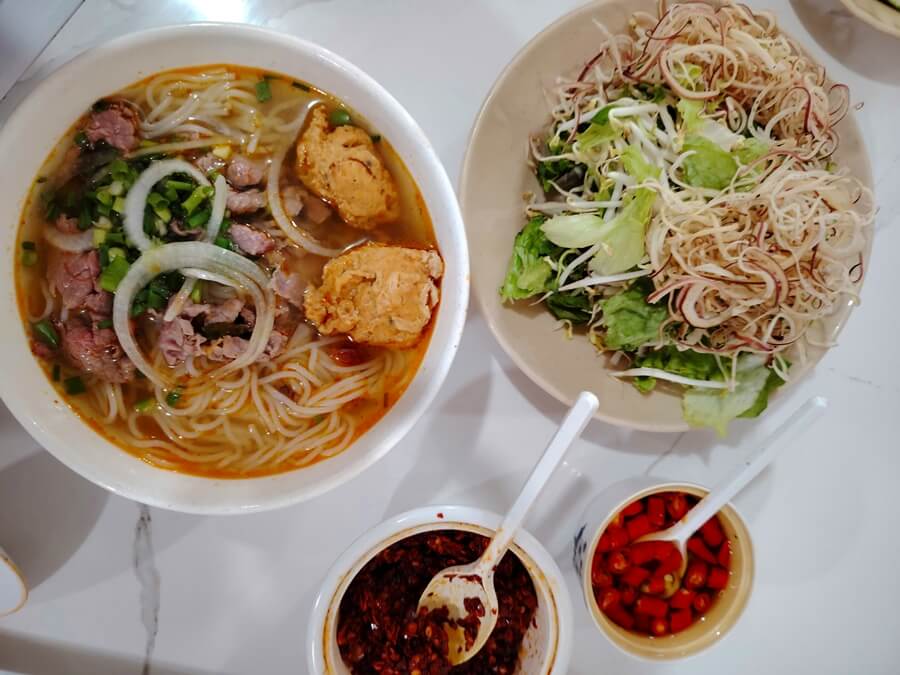
When eating Bun Bo Hue in its birthplace, you experience more than a meal. You experience the local rhythm of life, early morning conversations, steaming bowls on small tables, and the unmistakable fragrance of lemongrass rising with the heat of the soup.
3. Where to Eat Bun Bo Hue in Hue
Although Bun Bo Hue is available throughout Vietnam, tasting it in Hue offers a more authentic and balanced flavor. The broth tends to be richer in lemongrass aroma, deeper in color, and more pronounced in shrimp paste compared to versions served in other regions.
Bun Bo Hue – 19 Lý Thường Kiệt Street
Located in the city center, this address is convenient for visitors staying downtown. The broth is aromatic and well-balanced, with tender pork leg and properly chewy vermicelli noodles. Its central location makes it easy to combine with nearby attractions or a morning exploration of Hue.
Quán Cẩm – 45 Lê Lợi Street (along the Perfume River)
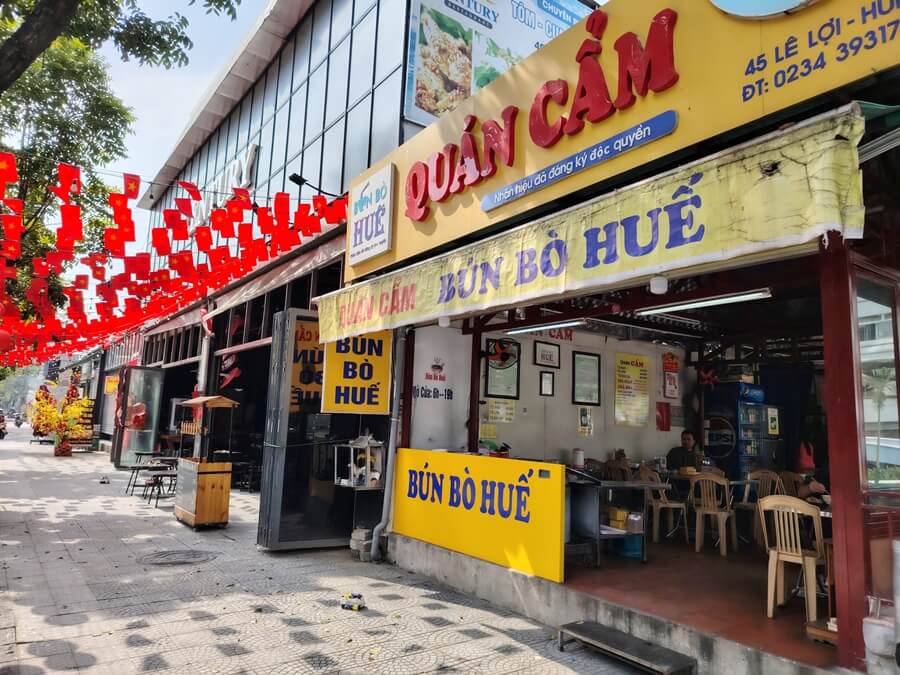
Situated on Lê Lợi Street, the scenic road running beside the Perfume River, Quán Cẩm is a suitable stop after visiting riverside landmarks. The broth here is slightly stronger in shrimp paste and chili oil, offering a more intense local flavor profile.
Beyond these well-known spots, many small neighborhood eateries serve excellent Bun Bo Hue, especially in the early morning. Some of the most authentic bowls are found in modest local restaurants tucked away in residential streets.
You can absolutely visit the local spots mentioned above and enjoy Bun Bo Hue on your own.
However, if you’re unsure what to order or how to choose between different bowl options, such as beef cuts, pork leg, or crab cake, a guided street food experience can make the process smoother and more insightful.
With a local food expert, you’ll learn how to order confidently, how to enjoy it properly, and what defines a truly authentic bowl of Bun Bo Hue in Hue.
4. Price of Bun Bo Hue in Hue (Updated 2026)
The price of Bun Bo Hue in its hometown remains affordable compared to many other Vietnamese cities, especially destinations with heavy tourism.
As of 2026, a standard bowl in Hue typically ranges from 30,000 to 60,000 VND per bowl (approximately $1.2–2.5 USD).
Local Eateries (30,000 – 40,000 VND)
In small neighborhood restaurants and traditional morning shops, prices usually fall between 30,000 and 40,000 VND. These bowls often feature a stronger shrimp paste aroma and a spicier broth, closer to the original local taste. Portions are generally generous, especially in places that mainly serve residents.
Central or Riverside Restaurants (40,000 – 60,000 VND)
In central areas or along streets near the Perfume River, prices typically range from 40,000 to 60,000 VND. These locations are more convenient for visitors and may adjust seasoning slightly to suit a broader range of tastes. The presentation is often more refined, with a balanced combination of beef slices, pork leg, and crab cake.
Extra Add-Ons
If you request additional beef, pork leg, or crab cake, the price may increase slightly. Even with extra toppings, Bun Bo Hue remains one of the most reasonably priced traditional dishes in Hue.
A bowl of Bun Bo Hue is both filling and energizing, making it a satisfying meal before a full day of exploring the city.
Price During Tet (Lunar New Year)
During Tet (Vietnamese Lunar New Year), especially from about three days before to five or six days after the holiday, prices may increase by 5,000 to 10,000 VND per bowl. This adjustment reflects higher ingredient costs and holiday service demand. After the Tet period, prices typically return to normal levels.
5. Bun Bo Hue vs Pho
In Vietnam, Bun Bo Hue is often compared with Pho because both are noodle soups built around rice-based noodles, meat, and broth. At first glance, they may appear similar. However, in flavor, structure, and culinary identity, they are distinctly different.
The most visible difference lies in the noodles. Pho uses flat, thin rice noodles, while Bun Bo Hue features round, thicker vermicelli strands. The vermicelli in Bun Bo Hue is slightly chewy and holds up well against its robust broth, whereas Pho noodles are softer and more delicate.
The broth is where the contrast becomes even clearer. Pho broth is typically clear and gently sweet, especially in southern versions. It is lightly seasoned and often contains little surface oil. In contrast, Bun Bo Hue broth is richer and more aromatic. It is simmered from beef bones and pork leg, infused with lemongrass, and traditionally seasoned with shrimp paste. A layer of red chili oil and annatto often floats on top, giving the soup its characteristic deep orange-red color.
The types of meat also differ. A bowl of Pho usually contains sliced beef or chicken. Bun Bo Hue, on the other hand, commonly combines several elements: stewed beef shank, slices of beef, pork leg, and sometimes crab cakes. This mixture creates a more complex texture and flavor profile.
Fresh vegetables served alongside the two dishes reflect regional styles. Pho is typically accompanied by basil, bean sprouts, coriander, and lime. Bun Bo Hue is served with thinly sliced banana flowers, various herbs, lettuce, and bean sprouts, ingredients that balance the strong broth and enhance the overall sensory experience.
Ultimately, both dishes represent important pillars of Vietnamese cuisine. Pho is known for its subtle elegance, while Bun Bo Hue is recognized for its bold, layered intensity. The choice between them often depends on personal preference, whether one favors a gentle, clear broth or a more powerful and aromatic flavor.
| Criteria | Bun Bo Hue | Pho |
| Noodle shape | Round, thicker vermicelli | Flat, thin rice noodles |
| Broth | Rich, lemongrass & shrimp paste | Clear, gently sweet |
| Color | Reddish with chili oil | Clear or light brown |
| Meat | Beef, pork leg, crab cake | Beef or chicken |
| Spice level | Medium to high | Mild |
| Typical region | Central Vietnam (Hue) | Northern origin, nationwide |
6. Short Recipe – How to Cook Bun Bo Hue at Home
Although Bun Bo Hue is best experienced in its birthplace, it is possible to recreate a simplified version in your own kitchen. The key lies in preparing a rich broth and balancing lemongrass, shrimp paste, and chili properly.
This recipe serves approximately 4–5 people.
Ingredients:
- 1 kg beef bones
- 300 g beef (shank or brisket)
- 1 kg pork leg (cut into large pieces)
- 200 g crab cakes (optional)
- 5–7 stalks lemongrass (crushed)
- ½ fresh pineapple
- 1–2 onions
- 1 medium piece of fresh ginger
- 2 spoons shrimp paste (adjust to taste)
- Fish sauce, sugar, pepper, seasoning powder
- Chili and chili oil
- Annatto oil (optional, for color)
- 1 kg round vermicelli noodles
- Fresh vegetables: lettuce, sliced banana flowers, bean sprouts, herbs, coriander, lime
Step 1: Prepare and Clean the Meat
Wash beef bones, beef, and pork leg with diluted salt water. Rinse thoroughly. This helps remove impurities and improves the clarity of the broth.
Step 2: Simmer the Broth
Place beef bones and beef into a large pot. Add crushed lemongrass, ginger, pineapple, and enough water to fully cover the ingredients. Bring to a boil, skim off foam, then reduce to low heat and simmer for 45–60 minutes.
The long simmering process extracts natural sweetness from the bones and creates the foundation of the soup.
Separately, cook the pork leg until tender but not falling apart.
Step 3: Build the Flavor
In another pot, lightly sauté lemongrass and chili in cooking oil. Add annatto oil if you prefer a deeper red color. Pour in the strained beef broth. Add onions and season gradually with fish sauce, sugar, and diluted shrimp paste.
Shrimp paste is essential for authentic flavor, but it has a strong aroma. Add it slowly and taste as you go. The broth should be rich, slightly salty, and aromatic, but not overpowering.
Slice the cooked beef thinly and return it to the broth along with the pork leg and crab cakes (if using). Let everything simmer gently for a few minutes.
Step 4: Prepare the Noodles and Vegetables
Boil the vermicelli noodles according to package instructions. Drain well. Arrange fresh vegetables on a separate plate: lettuce, banana flowers, bean sprouts, herbs, and lime wedges.
Step 5: Assemble the Bowl
Place vermicelli noodles into a bowl. Add slices of beef, pork leg, and crab cake. Pour the hot broth over the noodles. Garnish with chopped spring onions and fresh coriander.
Serve with raw vegetables, lime, and chili on the side.
Note on the Broth:
A proper Bun Bo Hue broth should taste slightly saltier than regular soup but lighter than braised dishes. When combined with noodles and fresh vegetables, the flavors balance naturally.
The final bowl should offer a harmony of tender meat, chewy noodles, fragrant lemongrass, and the distinctive depth of shrimp paste, capturing the bold character that defines Bun Bo Hue.
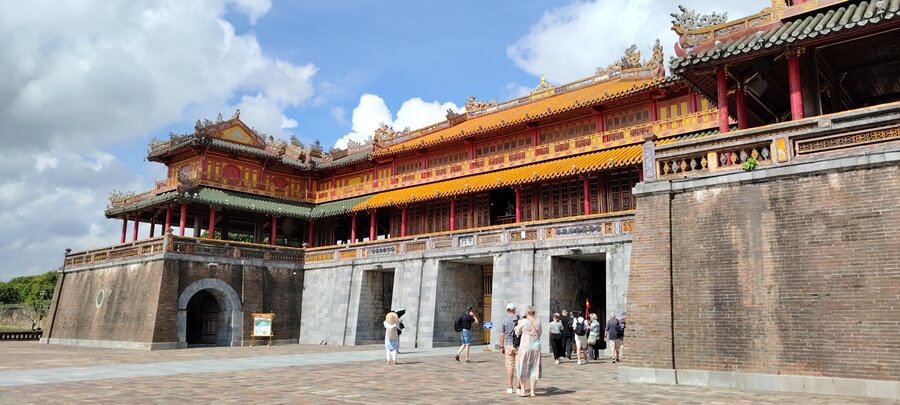
When visiting Hue, many travelers stop at local food spots to taste Bun Bo for lunch after exploring historical landmarks such as the Imperial City and riverside attractions. That’s a quick and nutrious meal, suitable for most of people.
One note when you order Bún Bò Huế: please tell the shop owner to add less or no chili if you can’t handle spicy food. Also, pay attention to the dark cubes called ‘huyết’ (cow blood) and put it on the side if you don’t like it.